Ocean Freight Rates continue rising now:
Over the past few months, international ocean freight rates has experienceed a significant increase. Rising fuel(eg.petroleum)costs, geopolitical uncertainty, and shipping capacity adjustments have all contributed to higher transportation expenses. According to the latest Drewry World Container Index, ocean freight rates on major shipping routes from Shanghai have experienced significant fluctuations over the past 12 months. The chart below illustrates the recent trend.Container freight rates from Shanghai declined throughout the second half of 2025 before rebounding sharply from May 2026. The strongest increase was seen on the Shanghai–New York route, while rates to Los Angeles and major European ports also rose significantly, indicating renewed pressure on global shipping costs. As a result, many importers are placing orders less frequently or delaying purchasing decisions to control logistics costs.
WCI index drops after 10 weeks of consecutive increase. Read the detailed assessment below: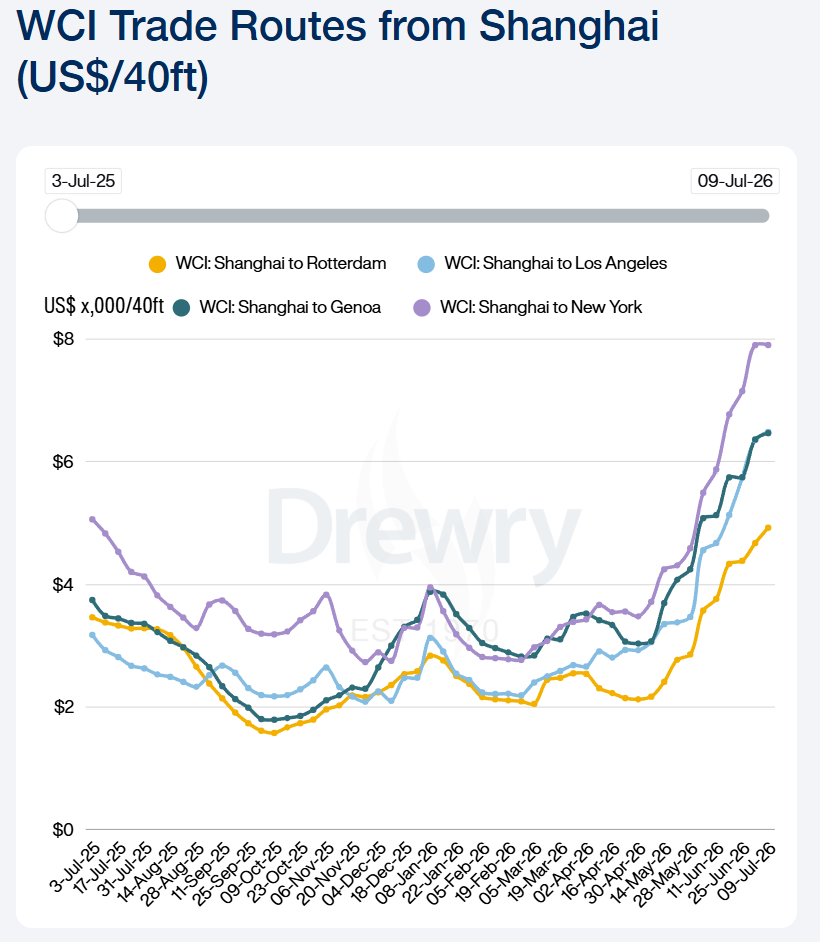
Sourse: https://www.drewry.co.uk/supply-chain-advisors/supply-chain-expertise/world-container-index-assessed-by-drewry?redirected=1&utm_source=chatgpt.com
Whether for businesses importing or exporting retail display fixtures, supermarket shopping trolley, and other store equipment, freight can currently represent a much larger percentage of the total project cost than before.
Why Many Importers Are Ordering Less Frequently Or Delaying
Facing the constantly rising logistic cost, many customers have begun to adapt more cautious strategies.
Many distributors and retailers are now:
- Reducing order frequency
- Ordering only essential products
- Delaying new store projects
- Comparing more suppliers before making purchasing decisions
- While these strategies bring short-term effect in reducing cost, they can also cause inventory shortages, longer project timelines and then missing business opportunities.
What about the challenges for manufactures
Obviously, the impact for manufactures is equally significant.
As overseas customers put off orders, factories often experience:
- Higher inventory levels (Higher storage cost)
- Slower production schedules
- Reducing factory operational efficiency
- Longer cash conversion cycles
To manufacuring firms, the new competitive focus has become how to help customers decrease the whole importing cost, rather than only just set lower prices.
 How Rubai Shop Fitting Supports Customers
At Rubai Shop Fitting, we understand those challenges because of fluctuating freight cost.
Therefore, our team makes up several relative measures for our customers:
- Designing products suitable for efficient container loading
- Offering customized retail fixture solutions
- Combining multiple product categories into one shipment
- Maintaining stable production schedules
- Providing reliable quality to minimize replacement costs
Looking Ahead
Freight markets will continue to fluctuate as global supply chains adjust to changing economic conditions.
Companies that prepare early, optimize procurement strategies, and cooperate with experienced manufacturers will be better positioned to manage uncertainty.
Contact UsIf you're planning your next retail fixture project, our team is ready to help you find the most cost-effective solution.
Email: sales@rubaishopfitting.comTele:0086-757-85444245
0086-18934397968

